Blog

Flexibility: Flexbox support for Internet Explorer

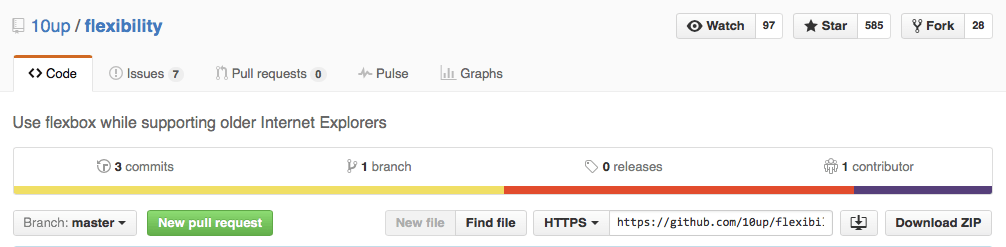
A few weeks ago, we pushed out our newest open source project: Flexibility, a polyfill that back ports Flexbox support to Internet Explorer versions 8 and 9.
Flexibility

Flexbox is one of the most significant advances in front end website layout since the advent of CSS, empowering us to build beautifully responsive and flexible layouts using pure, clean CSS. Here’s a short explanation from a great overview prepared by CSS-Tricks:

The main idea behind the flex layout is to give the container the ability to alter its items’ width/height (and order) to best fill the available space (mostly to accommodate to all kind of display devices and screen sizes). A flex container expands items to fill available free space, or shrinks them to prevent overflow.

Unfortunately, Flexbox support wasn’t added to Internet Explorer until version 10, leaving older versions – still popular in some corners – out of the Flexbox revolution. This idea didn’t sit well with 10up’er Jonathan Neal, tasked with engineering a beautiful layout for a Fortune 50 forced to contend with supporting older versions. We decided to subsidize his time to see if we could introduce Flexbox support under less-than-ideal browser requirements. The result was Flexibility: a smooth front end experience for older browsers, without compromising our ability to use pioneering layout technology.

Read More on Flexibility: Flexbox support for Internet Explorer
Reflections on ElasticPress

With 2015 coming to a close, I’ve been reflecting on the ElasticPress project’s accomplishments since its inception one and a half years ago.

Today, we released ElasticPress 1.7, which completely restructures post meta storage. This enables performant post meta queries with complex comparisons against data types, such as integers, dates, and times. We also fixed some bugs.

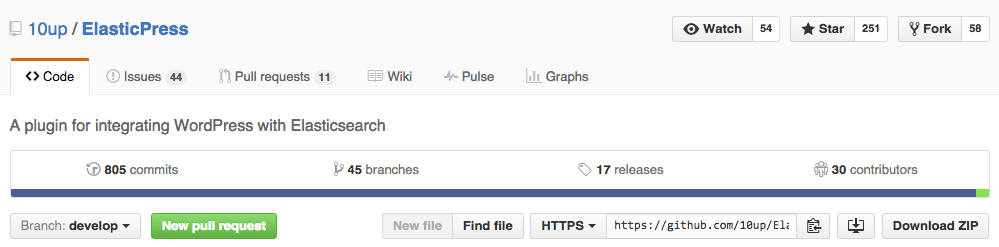
Like many of our popular open source projects, ElasticPress was originally conceived as an internal tool designed to support some specific client needs. Since open sourcing the project, ElasticPress has garnered over 30 contributors (most of whom do not work at 10up), 16 major releases, and a thriving Github community where developers and site owners are collaborating. ElasticPress is used by major hosting companies and across hundreds of websites, some of which serve millions of pages each month. I have introduced developers to ElasticPress at speaking engagements around the world.

elastic_press

We’ve also learned our fair share of lessons since initiating the project. Here are a few that stand out.
Read More on Reflections on ElasticPress

Button and link usability

I find myself often telling designers and front-end engineers that “buttons should feel like buttons and links should look like links.” It occurs to me, that after a few years of the flat design trend, I should explain what that means.

Buttons should feel like buttons

When you press a physical button in the real world — any key on a physical keyboard, for example — you can tactically feel it depressing. You’ll also see its form shrink away from you and the way the light falls on it will cause it to look slightly different.
Read More on Button and link usability

The First WordCamp US

WordCamp US

Philadelphia, Pennsylvania

Attending Speaking

In 2006, the first WordCamp was held in San Francisco–followed by subsequent camps in cities around the country. This weekend, the first WordCamp US will take place: an expansion of the traditional San Francisco conference, now attracting the WordPress community on an even larger scale.

Our team regularly contributes to open source projects and community initiatives, and I am thrilled to be one of seven co-organizers of the inaugural WordCamp US. Hosted in Philadelphia, PA on December 4-6, the conference is a jam packed 3-day event: kicking off with a yoga session right after registration, and moving through the weekend with more than 80 speakers and sessions, including 15-minute “Lightning Talks.” Matt Mullenweg will also present the annual “State of the Word” address: a summary on the current and future outlook of the WordPress project and community. The conference will conclude with Contributor Day: an event for novice and seasoned contributors to give back to the WordPress project, co-organized by colleague and Web Engineer, Drew Jaynes.

Read More on The First WordCamp US

Client’s “Great Thanksgiving Listen” Campaign Featured on Google Homepage

StoryCorps

We love when our clients are successful, and StoryCorps and their amazing Thanksgiving Listen campaign being featured on Google’s homepage certainly qualifies. The project, powered by the WordPress JSON REST API, is hosted on a custom Amazon Web Services stack created by our systems team to accommodate its highly unusual scaling requirements. Check out our earlier post about StoryCorps and consider using your own Thanksgiving to record your family stories!

From Shawnee, With Love: How A Small Town Inspires Remote Work

Shawnee article

Our distributed workforce model empowers 10uppers to work where they love, providing us with the freedom to create from inspiring places and spaces around the world.

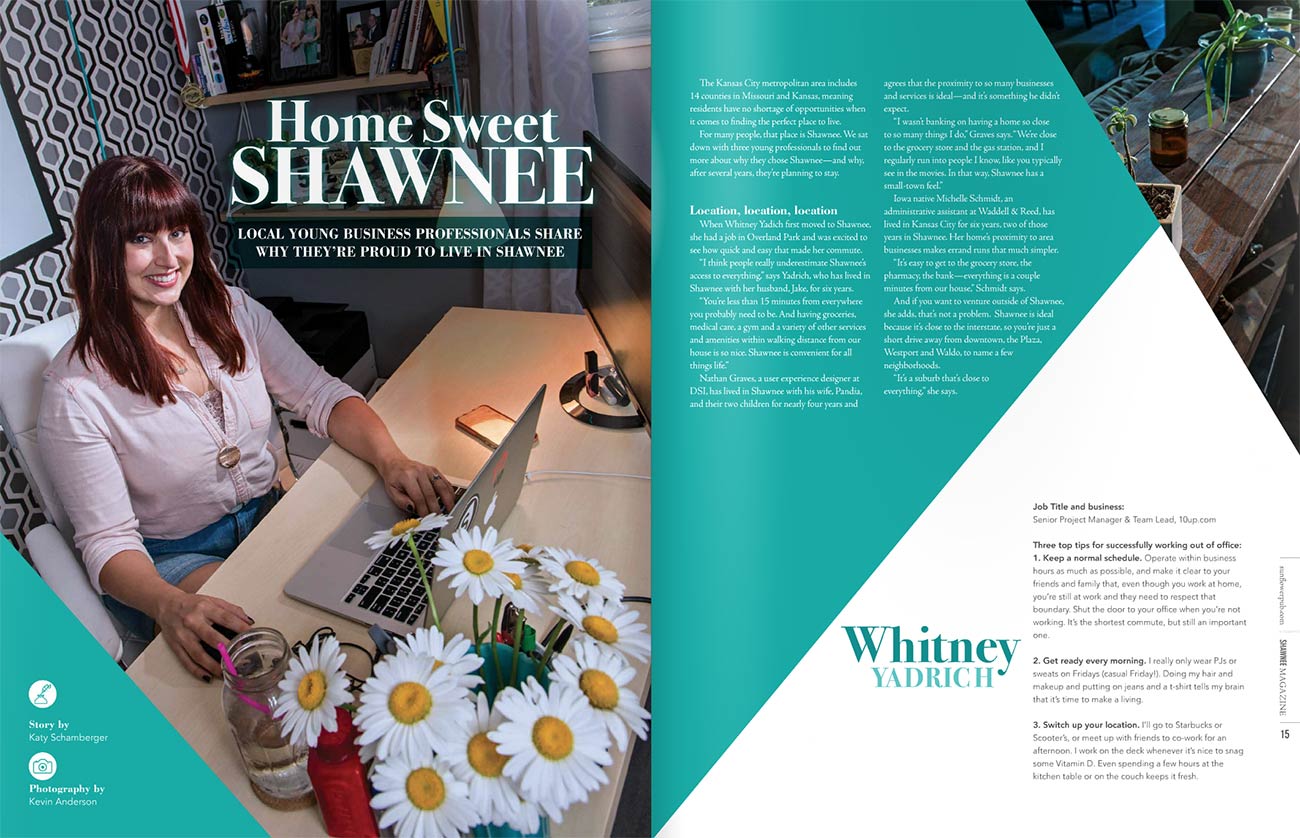
Take Whitney Yadrich, a Senior Project Manager & Team Lead over in Shawnee, Kansas where you’ll also find her husband, their two dogs (Lita and Sarge), and the town she fell in love with. Whitney was recently featured in the Fall/Winter issue of Shawnee’s local magazine, where she and two other young professionals dish on their love for their hometown.  Supported by our remote work culture, she credits the city for offering inspiring work spaces where she can change-up her scenery, recharge, and stay focused. Whitney also offers tips for the work-from-home professional, namely: prioritizing a normal work schedule, taking the time to get dressed every morning despite the lack of a mandatory commute, and switching up locations regularly to keep things fresh.

The First WordCamp Sacramento

WordCamp Sacramento

Sacramento, CA

Speaking Sponsoring

Rumors of a WordCamp Sacramento started in 2012, after I rebooted the WordPress Sacramento Meetup. Fast forward to 2015: there are 4 meetup organizers and northern California’s WordCamp San Francisco has been displaced by WordCamp US. The Art Institute of Sacramento volunteered its campus for an event, a professor offered himself as lead organizer, and indispensable local leaders stepped up to take an active role.

I’m proud to have played a small role in co-organizing the first WordCamp Sacramento, which takes place tomorrow, and even more proud that 10up is sponsoring the event. I’ll be joined at the event by three 10uppers who are speaking: Sacramento’s own Ben Ilfeld, who will be teaching site advertising basics, Northern California’s Vasken Hauri, who promises to improve lives with event-driven caching, and Luke Woodward, joining us from out-of-state to debut “Robots Write the Docs.”

10up speaks at WordCamp NYC this weekend

WordCamp NYC

10up is thrilled to sponsor WordCamp NYC 2015 this weekend in Brooklyn. This year, Chief Executive Officer John Eckman and I are presenting, with Director of Platform Experience Helen Hou-Sandi in attendance.

In “Modernizing WordPress Search with Elasticsearch”, I’ll cover the benefits of Elasticsearch and teach attendees how to use ElasticPress: a 10up plugin that integrates WordPress with Elasticsearch, and significantly improves search results, relevancy, ranking, and filtering within WordPress.

John’s presentation, “The Enterprise Disconnect: WordPress and the Complexity of Simplicity”, will cover the challenges of advocating for WordPress in the enterprise, and different perspectives inside and outside the WordPress community. John will propose approaches that preserve the simplicity of WordPress, while better exposing enterprises to powerful solutions which can be built atop the platform.

Read More on 10up speaks at WordCamp NYC this weekend

10up speaking at ZendCon 2015

ZendCon 2015

Las Vegas

Speaking

This year, Lead Web Engineer Eric Mann and I are attending and speaking at ZendCon, the largest global gathering of the PHP community, on October 19-22, 2015 in Las Vegas. ZendCon brings together industry thought leaders, recognized PHP experts, enterprise PHP adopters, as well as independent developers for four days of professional development and networking.

On October 19, Eric will present his first talk, “Sandboxing your Development Environment with Vagrant”, which covers best practices in developer-side virtualization and some of the options available for runtime system configuration. On Wednesday, he’s talking about WordPress and unit testing in “A Tale of Two Test Suites.” Eric will cover fundamentals like API mocking, and comparing and contrasting the standard WordPress integration test suite with mock-powered unit testing alternatives.

Also on Wednesday, I’ll  present “Best Practices for WordPress Enterprise”. I’ll explain how 10up successfully builds highly efficient and scalable WordPress websites for some of the world’s largest companies and organizations. Although I’m focusing on engineering, I’ll also touch on team coordination and workflows.

Reiterating our commitment to an open web

It’s easy to take open-source software for granted, and to forget that the Internet we use every day depends in part on the freely donated work of thousands of programmers. If open-source software is at the heart of the Internet, then we might need to examine it from time to time to make sure it’s not bleeding.

The Internet’s Telltale Heartbleed (The New Yorker)

I’m proud to be a part of 10up because we are eager to support a platform we use heavily and that powers a significant percentage of the web. I am sponsored full-time as one of the six lead developers of WordPress, and am very excited to announce further expansion of our support for WordPress. As a fellow committer for WordPress, Drew Jaynes will now also be enabled to work full-time on WordPress. Drew has been instrumental in creating awareness, standards, and output in our developer documentation, as well as contributing in many other areas in the core software and in community projects such as the WordPress.org site itself.

As a part of this expansion, we’ve created a Platform Engineer position and transitioned Drew to his new title. While we’re not currently hiring for the position, we’ve intentionally left the title open-ended as we continue to grow our support for and even build web platforms. We’ve dedicated significant resources to WordPress as well as projects like sanitize.css and VVV, and envision a future in which we continue to do the same elsewhere.

10up also has the rare opportunity to take advantage of a confluence of timing, a core WordPress initiative, and an employee who already runs the effort. We are doing this by donating 100 hours of Scott Kingsley Clark’s company time to the ongoing Fields API project, starting today. Scott has already assembled a strong group of contributors and laid a solid foundation and roadmap, and we feel strongly that supporting this initiative will help move it into a viable state for potential inclusion in a near-future release of WordPress. As a company with a central mission of creating great publishing experiences, the user and developer experiences a fields API can improve are something we are particularly well-versed in.

Read More on Reiterating our commitment to an open web