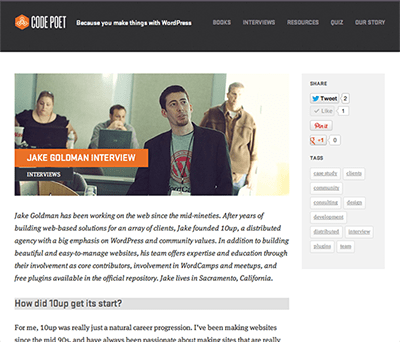
Rebecca Collins, an editor over at the recently refreshed CodePoet.com, has published an interview with me that explores 10up and our WordPress-focused web development business. Rebecca asked some great questions, and really challenged me to expand on topics I may have otherwise breezed over. In addition to articulating our focus on building really rich administrative experiences and supporting high scale sites, we really dived into what communication looks at a distributed company and how we respond to work opportunities that, on the surface, might initially seem like a poor fit. At 10up, we pride ourselves on transparency and sharing, and this very intimate look at our operational philosophies is no exception.
Updated 9/16/2012 with the latest version of the deck, presented at WordCamp Los Angeles.
Here are my slides from Enterprise Class WordPress – a talk I debuted at WordCamp Orange County last weekend. Like What Would Core Do?, the focus was on big ideas, not code. I found this difficult to formulate, largely because it involves a complex “problem” that’s more human than technical, and as such, requires a lot of generalizing. I do think that the underlying ideas are important to WordPress’s growth, and I’d like to see the conversation percolate. I plan to refine the talk and explore this with other communities and at other camps – starting with Boston. Please chime in with ideas!
WordCamp Boston has a very special place in my heart, as I helped organize the first camp back in 2010, and then made it the first event that 10up would sponsor back in 2011. We’re excited to be repeating our Silver Sponsorship in 2012. You can expect to see 3-4 members of team 10up at the event, and, hopefully, at least a few of us speaking. With a first class organizing team behind the event, one of the biggest meet ups in the country behind it, and a good old New England passion, you can expect this WordCamp to be every bit as amazing as the prior two!
I’m looking forward to meeting the Orange Country WordPress community in a few weeks (June 2-3) at their upcoming WordCamp, where I’ll be speaking.
Having taken the “fine-tuning administration” series as far as I can go (Hijacking WordPress Admin, Editing the Visual Editor, and What Would Core Do?), I’m turning my attention to another topic that’s near and dear to me: WordPress as an enterprise caliber content management solution.
There’s no question that WordPress has won the hearts and minds of the publishing industry, with everyone from the New York Times to TechCrunch embracing the platform. And WordPress is used by many huge business organizations, non-profits, and government entities – but usually, for microsites, a blog, or another “piece” of their publishing solution. WordPress still faces resistance from many big institutions in many verticals when it comes to that “enterprise CMS” need – the content management system that’s at the core of the organization’s online presence.
At 10up, we’ve had some big successes helping large organizations adopt WordPress as their central CMS, but we’ve also seen huge prospective opportunities ultimately shy away because of lingering hesitations about WordPress’s suitability to the enterprise class title. Some of the concerns are legitimate worries about its functional suitability to issues that only concern huge, international entities. Other concerns are more organizational – can huge companies use a CMS owned and managed by an open source “community”? Is WordPress a CMS meant for the million dollar project?
Extending a big “your welcome” in return for the “big thank you” from WordCamp New York City 2012 for our Bronze Sponsorship. The jury is still out on speaker applications, but expect to see a few 10up-ers from our northeast contingent at this anchor WordCamp on June 9-10.
The video from my WordCamp Phoenix 2012 presentation in the “Think Tank” track on “Next Generation Web” is up on WordPress.tv. This was a fun talk to give, a mix of theory on the evolution of web technologies, a high level technical overview and preview of some of today’s cutting edge open web technologies, and a sneak preview at what’s coming down the pike.
If you’re looking for a deep dive into the technical nuances of HTML5 and CSS3, this is not the talk for you. If you like thinking about technology trends, want a sampler of some hot technologies you can use today, and want to be inspired by what’s still ahead, I think you’ll enjoy the talk. You can find the slides here.
At 10up, responsive design is a hot request. In fact, over the course of the last year, we’ve seen this type of work evolve from relative indifference – when pitched – to a common client expectation.
It often makes sense to release a new “desktop” experience before rolling CSS3 media queries or other responsive techniques. Furthermore, you might invest in contextual layout for phone screens, but leave the “desktop” experience for tablet devices. While devices like an iPad or iPhone do a great job of rendering any web page (this was the original selling point!), there are cases where the layout calls for subtle changes. In one case, we needed to hide buttons that spawned unsupported technologies (e.g. Flash) on iOS devices. We also had to deal with a subtle but ugly iOS Safari quirk involving large background images.
It’s easy enough to write server side code (e.g. PHP) that changes the output based on the browser’s user agent, but if you need to work with page caching, server side code based on visitor specific properties isn’t an option.
The following simple JavaScript code snippet will add a “browser-ios” class to your body tag that will allow you to easily tweak elements with basic CSS, and without any server side concerns like page caching.
Back in February at WordCamp Phoenix, I participated in a panel on agencies, offering thoughts, experiences, and insights into the agency model. Great insights from my co-panelists, including WordCamp Phoenix’s lead organizer Dallin Harris, along with an engaged, packed audience, and superb moderation by Michael Eck added up to a fun and informative panel. Check out the video if you want some insight into the agency model, or a peak behind the current at the business of 10up and similar agencies.
This coming Monday, I’ll be delivering an encore presentation of WWCD? (What Would Core Do) at the monthly Boston WordPress Meetup. We’re also sponsoring the meet up – pizza is on 10up. If you’re in the Boston area, drop by and say hi!
Here are the slides from my talk at WordCamp Phoenix 2012. Presented in the “Think Tank” track, it explores some ideas and concepts that underlie change in web development medium, and introduces coding techniques for the last HTML5 / CSS3 capabilities. Here’s the description from the WordCamp schedule:
We’ve all probably heard of HTML5, CSS3, Responsive Design, and other “future of the web” buzzwords. Maybe you’ve even dabbled in HTML5 doctype declarations and “header” tags, or used CSS3 rounded corners or gradients. But most of us have only scratched the surface of these technologies, and for good reason – not everyone is using Chrome 16 or Firefox 9 yet, and even they haven’t settled on uniform implementations. We’ll look at how Responsive Design is already beginning to change the way we approach building sites for different screen sizes, and peak into potentially transformative HTML5 techniques that are only beginning to appear around the web.
 Jake Goldman on

 I’m looking forward to meeting the Orange Country WordPress community in a few weeks (June 2-3) at their upcoming WordCamp,