If we spent our first five years pioneering and staking our claim in the world, in our sixth year we cultivated the organization and culture we pioneered. We rallied around trends and shifts in our industry and redoubled our investment into telling our story.
The initiative to better express our story culminated in a refresh of our company website, prominently featuring a new mission statement, proudly summarized by a promise to deliver “finely crafted websites and tools that make the web better.” We reinvigorated our project case studies, moving to a layout that better celebrates the challenges we’ve conquered with our clients. And we completely overhauled our Careers section, taking deliberate strides to better represent our culture of diversity and inclusion.
We’re proud to announce ElasticPress.io: a hosted service that integrates with ElasticPress, our popular plugin, to provide a fast and flexible search and query engine for WordPress.
We built ElasticPress to overcome higher-end performance and functional limits posed by the more traditional, structured (SQL) database underpinning WordPress. Storing content in a modern (noSQL) query engine like Elasticsearch empowers us to produce superior keyword search and related content results, and supercharge the performance of complex queries like a filter on multiple product properties or a location. Smarter and faster content makes for a better web and, not accidentally, is important to search engines and visitor retention / conversion.
While our plugin made it simple for WordPress-savvy engineers to talk to Elasticsearch, the need to manage Elasticsearch hosting added friction and complexity, at odds with the simple user experience 10up strives for. As we prototyped exciting use cases involving private content, we realized that end-to-end security added even more complexity.
ElasticPress.io solves all of that—making it dead-simple to start using enterprise-caliber search and query technology with WordPress. It enables innovative features like accelerated admin performance that require end-to-end control and security.
In celebration of another successful year, 10up will be on holiday break from Friday, December 23 through Monday, January 2. We’re looking forward to recharging our collective batteries, as we prepare to buckle in for 2017.
What, exactly, does the “average” 10upper do with 11 days away from the virtual office, anyhow?
More than two years ago, we overhauled 10up.com to reflect the company we had become. Conceived and built entirely in-house, we strove for an experience and aesthetic that would project the craftsmanship we offer our clients. More than two years later, we think the art direction and architecture has more than withstood the test of time.
Over the last two years, our mission, message, and value proposition has evolved, presenting an opportunity to improve the way we articulate ourselves, in content and design. I’m happy to announce a site wide update that highlights our refreshed mission statement and improves the way we describe #team10up.
We think that our own story becomes most tangible when telling our project stories, so we’ve also taken the time to completely redesign our work portfolio. Our user experience and visual design team worked closely with internal stakeholders and engineers to craft a portfolio that is as visually stunning as it is functional, across screen sizes and device types.
WordPress 4.5 was released yesterday, featuring improvements to content editing, responsive previews, and a handful of under the hood performance and developer improvements. More than a dozen 10uppers made this release possible, most notably Adam Silverstein, who served as Release Deputy.
Thank you for helping make WordPress: David Brumbaugh, Drew Jaynes (emeritus), Dreb Bits, Faishal Saiyed, Helen Hou-Sandí, Josh Levinson, Lukas Pawlik, Pete Nelson, Ricky Lee Whittemore, Ryan Welcher, Scott Kingsley Clark, Steve Grunwell, and Sudar Muthu!
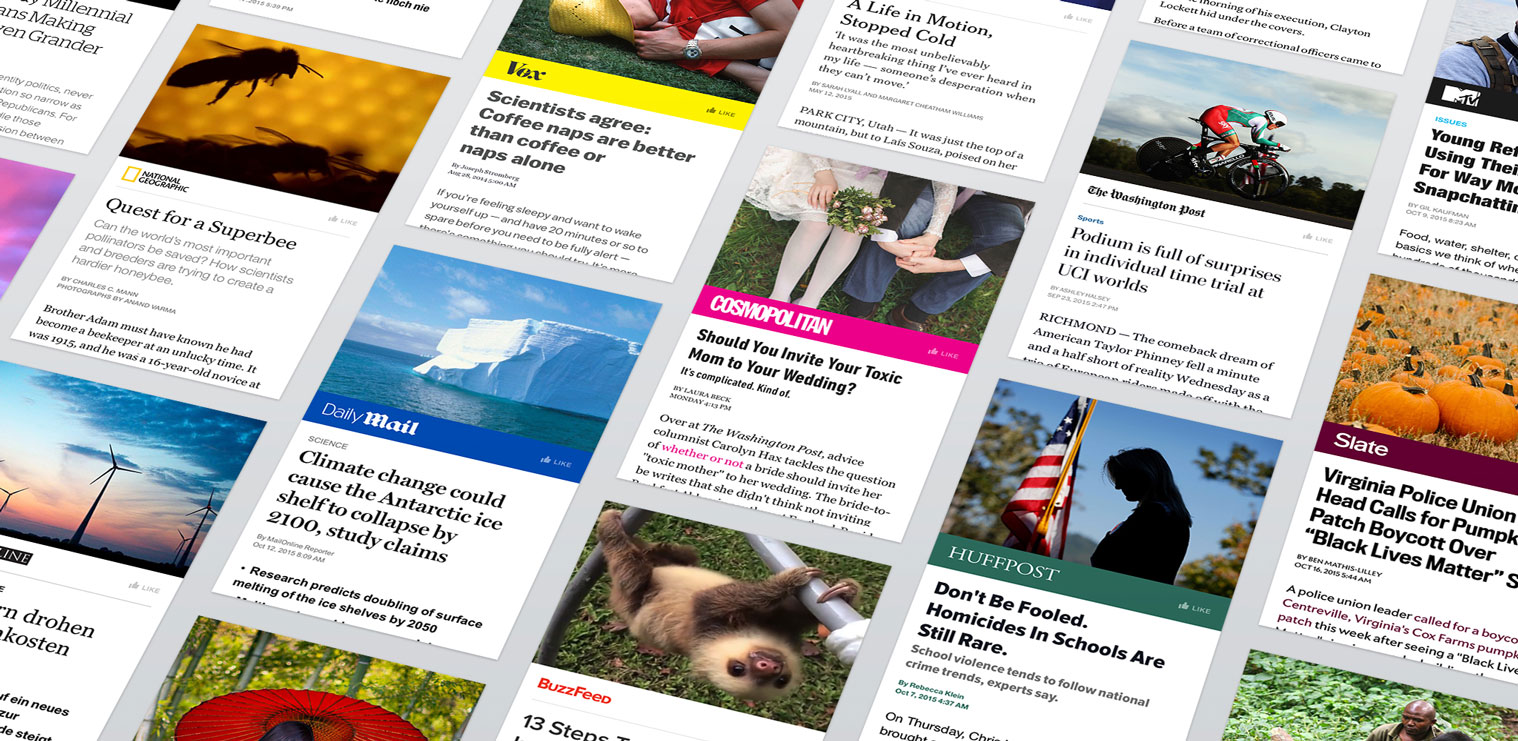
On April 12, Facebook is expanding their in-app Instant Articles program—which delivers lightweight, instantly loading articles—to all publishers. All content creators, from enterprises posting corporate news to your neighbor’s food blog, can start taking advantage of the benefits of Facebook Instant Articles to maximize engagement with Facebook’s 1.5 billion users.
We see Instant Articles as another step toward the content management system (CMS) as the hub for creating and delivering content. Content creators are distributing to many interfaces and channels: HTML/CSS front ends, mobile apps, third party sites, Google AMP, Apple News feeds…even print publications! Rapidly evolving content distribution punctuates the benefits of an open and well-maintained CMS. WordPress adopters can rapidly benefit from channels like AMP and Instant Articles thanks to quickly released and well supported open source modules, circumventing the development overhead of a home grown platform or the long roadmap of a niche commercial CMS, and without surrendering their content to closed platforms like Medium.
Seamless integrations with platforms like Instant Articles is why 10up so fervently advocates for WordPress and the open web. And so, upon Facebook’s 12th anniversary, here are 12 key insights for publishers using WordPress and preparing for Facebook Instant Articles.
Our origin story is modest: just five years ago, 10up began with a single individual working in the smallest U.S. state and a portfolio containing fewer clients than there were Star Wars movies at the time.
Since then, 10up has matured at a much faster pace than your average agency. We’ve continued to grow our team by ~30%, welcoming dozens of new 10uppers across Project Management, Web Strategy, Engineering, Design, Revenue, and User Experience. Financials also continue to thrive; in the first month of 2016, we saw more revenue than our first two years combined (and more than half of what we did in our third year).
But here at 10up, we value more than revenue and growth statistics—it’s about nurturing the culture within, providing our team the resources to achieve peak performance—a sense of community, a pride of ownership, and material benefits for a team that is building a future together, not merely cashing in a paycheck.
In 2015, we hosted our biggest All Hands Summit, practically taking over a hotel in Boulder for a 10up-only conference with sessions exploring our business goals, emerging and important technologies, and the latest tactics for effective project management, with a healthy dose of team building. We even hosted an awards ceremony: The First Annual Uppies – a tradition is born.
As we continue to strive for the very best consulting experience in the publishing and content management space, here are just a few accomplishments since our last birthday:
We now spend more time on mobile gadgets than on desktop devices. The mobile web experience is more important than ever, and overwhelmingly defined by content relevancy, timeliness, and above all, speediness.
Mindful web developers—given adequate budget allowances—strive to build mobile-first sites that provide lean, engaging experiences across different screen sizes and devices. These sites better retain their audience because the experience is enjoyable and, in some cases, because impatient readers will leave (“bounce”) rather than wait for a clunky web page. Because Google recognizes its customers’ preference for performant sites, it factors pagespeed into its search algorithm, boosting speedy sites in search results.
In spite of these incentives to minimize page weight, most websites are heavier than ever. High resolution displays ushered in huge images, and universal support for custom typography has us downloading fonts everywhere. While the renaissance in front end toolkits like jQuery and React.js eases development and alleviates server-side scaling, it has done so at the expense of pushing more assets and processor strain to the browser. Most problematically, today’s website monetization and measurement tools often deliver heavy (and invasive) ads with little incentive to improve.
Much of this “bloat” has been obfuscated by our increasingly powerful devices, improving mobile broadband connections (especially among the “creative” class), and increasingly competitive browser technology. Even so, publishers are clearly testing (or even lazily trampling) acceptable boundaries, creating an opening for ethically gray solutions like iOS 9’s content blockers, and more closed platforms like Apple News.
Enter the Accelerated Mobile Pages (AMP) project: an open source initiative based on existing open web standards led by Google, touting noble intentions to improve the mobile web experience by providing standardized, lightweight guidelines and tools for developers. AMP HTML versions of web pages trade complex functionality and capabilities for lightness, simplicity, and a focus on content, resulting in near instant load times.
While there may be more transformative long-term potential for AMP as a framework, in the near-term, Google’s initiative is hyper-focused on improving news and media consumption. In essence, AMP competes with the self-contained, largely closed, and far more restrictive experiences offered by Apple News, Facebook Instant Articles, and the rumored “long-form format” coming to Twitter (among others). Publishers opting to offer AMP’s lean presentation will be rewarded with increased visibility in mobile search results for news, including Google’s News Carousel: the highly coveted positioning at the top of mobile search results.
 Jake Goldman on




 On
On